


Custom Software vs 20€/Month SaaS: When Is It Really Worth Building Your Own Solution?
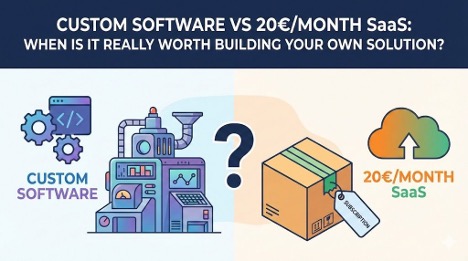
Every growing business reaches the same point:
“Should we build our own software… or just pay for another 20€/month tool?”
Off-the-shelf SaaS (Software as a Service) is attractive: it’s cheap, fast to start, and “good enough” for a lot of use cases. But at a certain level of complexity, these tools become a limitation: your team hacks together spreadsheets, duplicates data, and spends more time fighting the tools than serving customers.
This article will help you understand when a SaaS subscription is more than enough and when custom software becomes the smarter, long-term decision.
When a 20€/month SaaS is enough
You don’t need custom software for everything. In many cases, using existing tools is the most efficient decision you can make.
Typical situations where SaaS is the right choice:
- Standard, well-defined processes
- Simple invoicing
- Basic CRM to track leads and customers
- Project/task management for a small team
- Simple newsletter/email marketing
If thousands of businesses are doing exactly what you’re doing, there is probably a good SaaS that already fits.
- Small team, low complexity
- A team of 3–10 people
- Few departments, simple approvals
- No complex internal workflows
At this stage, what you really need is discipline and procedures, not a huge custom platform.
- You’re still validating the business model
- You don’t yet know how your processes will look in 6–12 months
- You’re experimenting with offers, pricing, countries, sales channels
In this phase, custom software is often premature. You’d be building today something that you may no longer need in a year.
- No strong need for integrations
If your tools can stay separate (CRM, email, invoicing) and your team is fine with switching between them, a SaaS stack is totally acceptable.
Rule of thumb:
If your process can be described in one sentence, and you don’t have more than a few dozen operations per day, SaaS is usually enough.
When custom software becomes the smart move
Custom software makes sense when your way of doing business is an advantage – and existing tools can’t follow.
Signs that it’s time to think about a custom solution:
- You have unique workflows that SaaS tools cannot model
- Many conditions, exceptions, special approval rules
- Industry-specific steps (e.g. medical protocols, logistics constraints, compliance rules)
- Your team constantly says: “This tool is good, but we also need this one thing…”
When your processes are twisted just to fit into existing tools, you’re losing efficiency.
- You live in spreadsheets and manual copy-paste
- Export from system A → process in Excel → import in system B
- People reconcile data manually at the end of the day
- You depend on one “Excel wizard” who knows how everything works
This means your business has already outgrown generic software.
- You need deep integrations
- ERP, warehouse, accounting, CRM, ecommerce, payment systems, delivery, marketing…
- Data needs to flow automatically between multiple tools
- You want a single source of truth instead of conflicting reports
At that point, custom software can serve as a central brain that orchestrates everything.
- You have volume and risk
- Thousands of transactions, bookings, orders, medical records, financial operations
- Every error costs real money, reputation, or legal trouble
For this level, “good enough” tools are no longer enough. You need a system designed specifically for your scale and constraints.
- Your software becomes part of your competitive advantage
- Customers interact with your platform directly (portals, apps, dashboards)
- The experience you offer is part of why clients choose you
- You want features no competitor has yet
In this case, using the same SaaS tools as everyone else puts a hard cap on your differentiation.
How to estimate the ROI of custom software
Custom software is an investment, not just an expense. But you need to quantify it.
Here’s a simple framework you can use.
- Time saved
- Estimate how many hours your team loses every week on:
- Manual copy-paste
- Duplicate data entry
- Searching for information in scattered systems
- Fixing mistakes
- Multiply that by their hourly cost.
- Check what happens over 12–24 months.
If a custom system can eliminate a big part of that wasted time, you can quickly see the monetary impact.
3.2. Errors reduced
- How many errors happen monthly?
- What is the average cost of an error? (refunds, penalties, lost clients, reputation)
Even a moderate reduction in errors can pay for a custom solution over time.
3.3. Extra revenue enabled
- Can a better system let you serve more clients with the same team?
- Can you launch a new service line or subscription because of the software?
- Can it provide better analytics so you stop losing money on unprofitable products/customers?
These effects are often larger than the cost savings.
3.4. Intangible, but real
Some benefits are harder to quantify, but still crucial:
- Happier employees (less chaos)
- Faster onboarding of new staff
- Stronger brand perception (professional client portals, apps)
When you combine all of these, custom software often pays for itself within a few years – sometimes much faster.
How WaveIT approaches a custom software project
A smart decision is not just “custom vs SaaS”, it’s also “how we build custom”.
At WaveIT, we typically follow a structured path:
- Evaluation & Design
- We map your existing processes: what really happens in your company, not what’s written in manuals.
- Identify bottlenecks, manual work, and risks.
- Design the minimum viable version (MVP) that already brings clear value.
- MVP first, not “big bang”
- We don’t propose immediately a huge, two-year project.
- We start with the core flows, automate the most painful parts, and put the system in the hands of users quickly.
- Iterative development
- Based on feedback from real users, we refine, extend, and integrate further systems.
- We prefer a long-term partnership over short, isolated projects.
- Support & updates
- After launch, the system grows with your business: new modules, new integrations, performance improvements, security updates.
The goal is not “to build an app”, but to build a living system that supports your business long term.
How to decide what you need
If your business is small, your processes are simple, and you’re still experimenting, a 20€/month SaaS stack is usually the best choice. Don’t over-engineer.
If, however, you recognize yourself in these symptoms:
- Your team lives in Excel and copy-paste
- You constantly struggle to make generic tools fit your real workflows
- You manage high transaction volume or sensitive data
- Your digital experience is part of your competitive advantage
…then it’s probably time to explore a custom solution.
You don’t have to decide alone or jump blindly into a big project.
A structured evaluation & design phase can clarify:
- What should stay on SaaS
- What deserves custom development
- What realistic budget and timeline makes sense for you


