


Build vs Buy: A Strategic Framework for Software Decisions
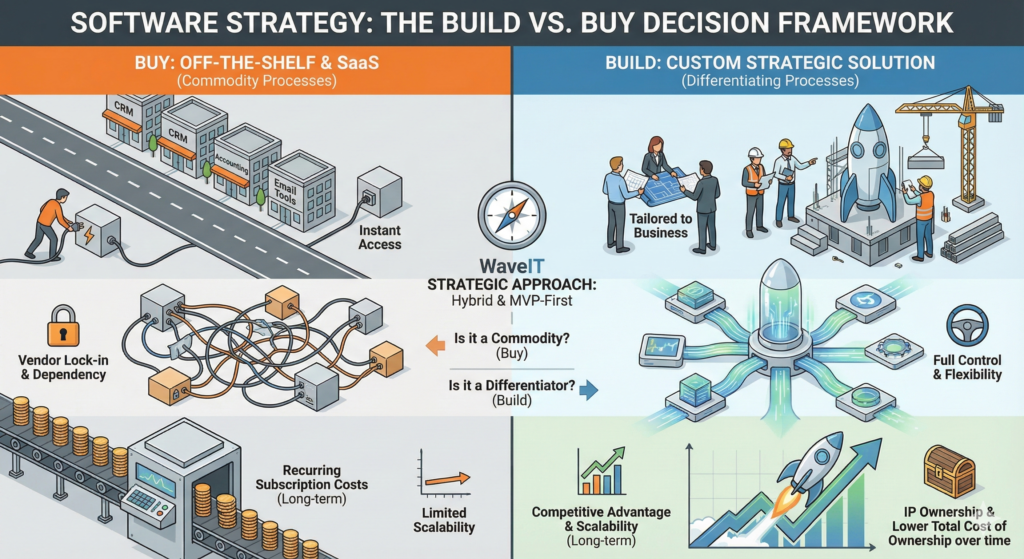
One of the most important technology decisions a company can make is whether to build custom software or buy an existing solution.
It’s a decision that impacts:
Yet many companies approach this choice emotionally or superficially:
In reality, build vs buy is a strategic decision, not a technical one. This article provides a clear framework to help you decide when to build, when to buy, and how to avoid costly mistakes.
1. What “build” and “buy” really mean
Before comparing options, it’s important to clarify the terms.
Buy
Buying software usually means:
Advantages:
Limitations:
Build
Building software means creating a custom solution tailored to your business:
Advantages:
Limitations:
The key question is not which is cheaper, but which supports your strategy long-term.
2. The core strategic question
The most important question in any build vs buy decision is:
Is this process a commodity or a differentiator?
Commodity processes
These are processes where:
Examples:
For commodities, buying is usually the smarter choice.
Differentiating processes
These are processes that:
Examples:
For differentiators, building often creates long-term advantage.
3. Short-term speed vs long-term cost
Buying software often feels faster—and it usually is at the beginning.
The short-term reality of buying
But over time:
The long-term reality of building
But:
Strategic decisions must look beyond the first 6 months.
4. Flexibility vs dependency
Buying creates dependency
When you buy:
You adapt your business to the software.
Building creates control
When you build:
Control becomes increasingly valuable as complexity grows.
5. Integration complexity as a decision trigger
One of the clearest signals that “buy” is no longer enough is integration pain.
Signs include:
At this point, custom software can act as a central orchestration layer, connecting systems into a coherent whole.
6. Risk management and scalability
Buying risks
Building risks
Risk doesn’t disappear—it shifts. The goal is to manage it strategically, not avoid it blindly.
7. A practical build vs buy framework
Ask yourself:
Your answers will usually make the decision obvious.
8. How WaveIT helps companies decide wisely
At WaveIT, we don’t default to “build everything.”
Our approach:
The best solution is often a smart combination, not an extreme.
Build vs buy is not about technology—it’s about strategy.
The right decision today prevents expensive migrations tomorrow.


