


What Happens After Launch? The Truth About Software Maintenance
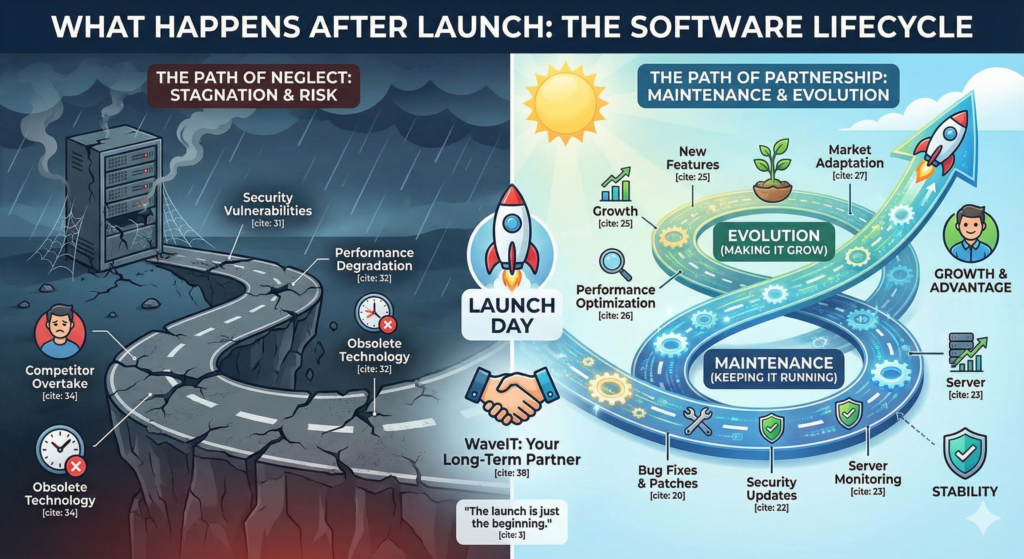
For many companies, launching software feels like crossing the finish line.
The app is live. Users can log in. The project is “done”.
In reality, launch is not the end of the software lifecycle—it’s the beginning.
The success or failure of a digital product is determined not only by how it’s built, but by how it’s maintained, evolved, and supported over time. This article explains what really happens after launch and why software maintenance is a strategic investment, not a hidden cost.
1. Launch is the moment reality begins
Before launch:
After launch:
No matter how well a system is designed, reality always reveals new needs.
2. Maintenance is not just “fixing bugs”
Many companies associate maintenance with:
In reality, maintenance includes much more.
Core components of software maintenance
Fixing bugs and unexpected behavior.
Adjusting the system to:
Improving performance, usability, and efficiency based on real usage.
Refactoring and updates that reduce future risks and technical debt.
Neglecting any of these areas increases long-term cost.
3. Why software degrades without maintenance
Software is not static. Over time:
Without maintenance:
The cost of “doing nothing” is often higher than the cost of proper maintenance.
4. Security and compliance: a moving target
Security is not a one-time checklist.
After launch:
Unmaintained software becomes an easy target.
Regular updates, monitoring, and audits are essential to protect data, reputation, and legal standing.
5. Performance and scalability under real usage
Load tests are simulations.
Real users create real pressure.
Common post-launch challenges:
Maintenance ensures the system scales with the business, not against it.
6. Feature evolution driven by real users
The most valuable features are often discovered after launch, through:
Maintenance enables:
Great software evolves continuously.
7. The real cost of ignoring maintenance
Companies that skip maintenance often face:
Maintenance spreads cost over time and prevents painful “all-at-once” recoveries.
8. How WaveIT approaches post-launch maintenance
At WaveIT, maintenance is part of the strategy, not an afterthought.
Our approach includes:
We treat software as a living system, not a one-off delivery.
Launching software is a milestone—not a destination.
Sustainable success depends on:
Companies that plan for life after launch build software that lasts, scales, and delivers long-term value.


